


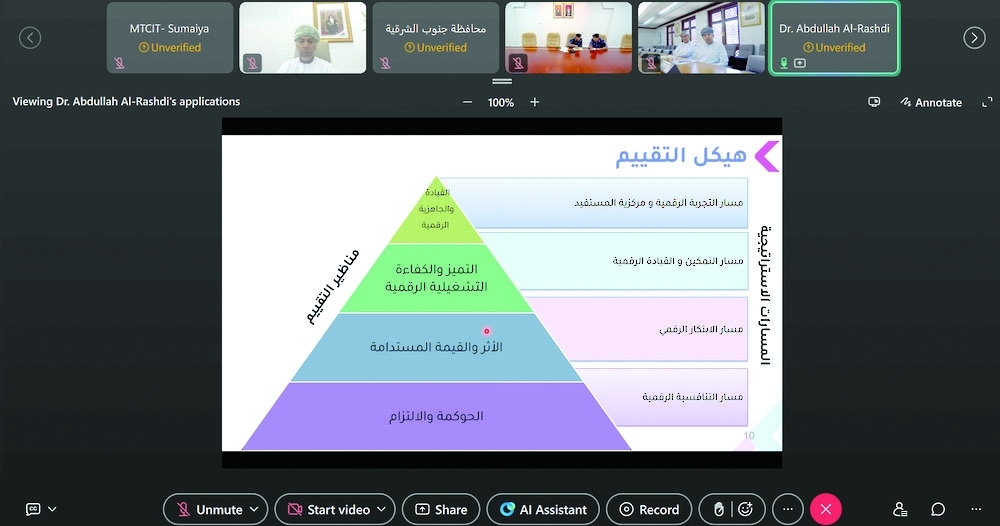





MUSCAT: A meeting held via video conferencing reviewed the strategy and general framework for measuring digital excellence for the National Digital Transformation Programme for 2026–2030.
The meeting was chaired by Dr Ali bin Amer al Shaithani, Under-Secretary of the Ministry of Transport, Communications and Information Technology for Communications and Information Technology.
During the meeting, the pillars for measuring digital excellence for the National Digital Transformation Programme 2026–2030 were addressed.
At the forefront was the Digital Leadership and Readiness pillar, which focuses on the ability of institutions to strategically direct digital transformation through clarity of vision, effective governance, and the integration of technical and human capabilities, alongside establishing a digital culture and ensuring investment sustainability.
The meeting also covered the Digital Operational Excellence and Efficiency pillar. This area is concerned with transforming operations and services into highly efficient digital models that contribute to reducing waste and enhancing performance quality through automation, process improvement, data utilisation and simplifying the user experience.
Furthermore, the meeting touched upon the Impact and Sustainable Value pillar, which aims to measure the actual return of digital transformation at the national, institutional, and beneficiary levels.
This is achieved by realising sustainable financial, operational, strategic and community value, supported by measurable performance indicators.
Meanwhile, the Governance and Compliance pillar focused on monitoring the commitment of entities to applying information technology governance. This involves establishing clear organisational structures, defining roles and responsibilities, and adopting policies and procedures for data and information management, thereby supporting data-driven decision-making and enhancing compliance with relevant national systems and standards.
The meeting also addressed the National Digital Transformation Strategy 2026–2030. This strategy aims to improve the user experience for digital services, utilise artificial intelligence, enhance beneficiary participation and trust in government digital services, empower national competencies, support decision-making, and increase the impact of digital governance. It further seeks to accelerate digital transformation in the priority economic sectors of the 11th Five-Year Plan by employing advanced technologies, promoting innovation and digital development as a sustainable institutional approach in the government sector, and consolidating the global position of the Omani digital economy as a key driver for sustainable growth.
The meeting additionally witnessed a discussion on the professional services initiative to enable digital transformation. This was alongside presenting a number of visions and proposals within an open discussion framework, contributing to supporting the implementation of the programme's objectives and enhancing the readiness of government entities for digital transformation. — ONA
Oman Observer is now on the WhatsApp channel. Click here


